Custom Logo Iron-On Patches
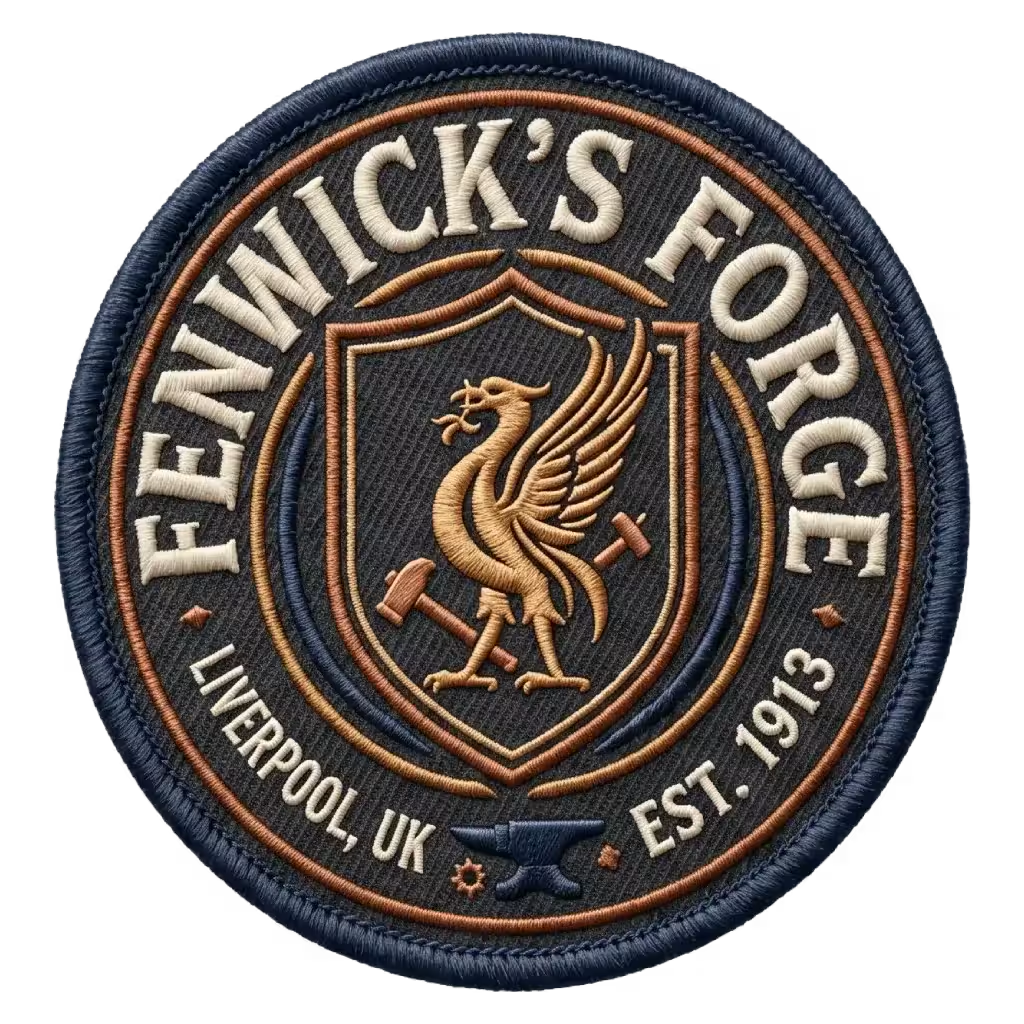
Custom logo iron-on patches are heat-applied embroidered or woven badges that reproduce your brand logo on fabric using a thermoplastic adhesive backing. We manufacture them in the UK with Pantone-matched threads, free embroidery digitising, and no minimum order, ideal for uniforms, workwear, merchandise, team kit, and corporate apparel.
- UK Made
- Free Digitising
- No Minimum Order
- Pantone-Matched
BackedCustom Logo
What Are Custom Logo Iron-On Patches?
Custom logo iron-on patches are bespoke embroidered, woven, or printed patches that carry a brand logo and bond to fabric through a heat-activated adhesive layer. Each patch combines a twill fabric base, a stitched or printed logo surface, a finished border, and a thermoplastic backing that melts under heat and fuses the patch to the garment. UK brands use these patches to add a permanent logo to workwear, uniforms, jackets, caps, and promotional clothing without sewing.
Core Components of a Logo Iron-On Patch
A custom logo iron-on patch contains four engineered layers, and each layer has a specific function in the final product:
- Twill fabric base - the woven polyester or cotton-twill foundation that holds the embroidery and gives the patch its structural body.
- Embroidered or woven logo surface - the visible logo, stitched in thread or woven into the fabric, reproducing the artwork in colour and detail.
- Merrow or laser-cut border - the finished edge that seals the patch perimeter; a merrow border creates a raised overlocked rim, while a laser-cut border produces a clean, flat die-cut edge.
- Heat-activated adhesive backing - a thermoplastic film bonded to the rear of the patch that melts between 130°C and 160°C and fuses the patch to the garment fibres.
Why Iron-On Backing Suits Logo Patches
Iron-on backing suits logo patches because brand logos are applied at scale and need a fast, repeatable application method. Heat-seal adhesive bonds the patch to the fabric in under 30 seconds, removes the need for sewing equipment, and produces a clean professional finish on uniforms, T-shirts, hoodies, polos, and caps. UK businesses choose iron-on backing for in-house branding runs because one team member with a standard household iron or a small heat press can apply hundreds of logo patches in a single shift.
Types of Custom Logo Iron-On Patches
Custom logo iron-on patches come in four primary types, and each type reproduces a logo through a different manufacturing process. The choice between embroidered, woven, printed, and PVC depends on logo complexity, colour count, texture preference, and intended garment.
Embroidered Logo Iron-On Patches
Embroidered logo iron-on patches use polyester or rayon thread stitched onto a twill base to create a raised, tactile logo surface. Stitch count typically starts at 1,500 stitches for a small logo and scales with size and detail. Best for bold, simple logos with 1–6 colours, such as workwear branding, club crests, and uniform identification.
Woven Logo Iron-On Patches
Woven logo iron-on patches use fine polyester threads woven directly into the fabric, producing a flat, smooth surface with high detail resolution. Thread density is far higher than embroidery, allowing fine text, gradients, and intricate logos down to 30 mm in size. Best for detailed corporate logos, fashion labels, and small badges with multiple elements.
Printed Logo Iron-On Patches
Printed logo iron-on patches use dye-sublimation or digital printing to reproduce the logo on a polyester base, capturing photographic detail and unlimited colours. Surface is smooth and lightweight, with no thread texture. Best for full-colour logos, gradient artwork, event branding, and promotional patches where colour fidelity outweighs texture.
PVC Logo Iron-On Patches
PVC logo iron-on patches use a moulded polyvinyl chloride material that produces a 2D flat or 3D raised logo with sharp edges and waterproof durability. Colours are mixed at the moulding stage and never fade. Best for outdoor brands, tactical workwear, and rugged use cases where the patch must resist water, abrasion, and UV exposure.
Embroidered vs Woven Logo Iron-On Patches, Which Suits Your Logo?
Embroidered and woven logo iron-on patches reproduce a brand logo through different textile processes, and the right choice depends on logo detail, size, and the texture you want on the finished garment. Embroidered patches stitch thread onto a fabric base and produce a raised tactile surface. Woven patches interlace fine threads at fabric level and produce a flat, high-detail surface.
| Attribute | Embroidered Logo Patch | Woven Logo Patch |
|---|---|---|
| Detail Resolution | Medium, bold shapes | High, fine text and lines |
| Surface Texture | Raised and tactile | Flat and smooth |
| Thread Type | Polyester or rayon | Fine polyester |
| Logo Suitability | Bold, 1–6 colour logos | Detailed, multi-element logos |
| Minimum Size | 50 mm | 30 mm |
| Typical Use | Workwear, jackets, caps | Corporate, fashion labels, shirts |
| Premium Look | Heritage and craft feel | Clean and modern feel |
Embroidered iron-on patches suit logos with clear typography, distinct shapes, and a heritage aesthetic, think construction workwear, hospitality uniforms, and sports club crests. Woven iron-on patches suit logos with small text, detailed graphics, gradients, or multi-element compositions, think corporate branding, designer labels, and tech-company merchandise. Both options accept the same heat-seal iron-on backing, so the application process remains identical.
How We Make Your Custom Logo Iron-On Patches
Every custom logo iron-on patch passes through a six-step production workflow at our UK manufacturing facility. The process converts your brand logo into a stitch-ready or weave-ready file, manufactures the patch in your chosen specification, applies the iron-on backing, and despatches the finished order across the UK.
Step 1 - Artwork Submission
You submit your logo as a vector file (AI, EPS, SVG, or PDF) or as a high-resolution PNG at minimum 300 DPI. Our design team reviews the artwork for reproduction feasibility at your chosen patch size and confirms colour count, dimensions, and border preference.
Step 2 - Embroidery Digitising
Our digitising team converts your logo into a machine-readable stitch file (DST or EMB format) that controls every needle movement on the embroidery machine. Digitising determines stitch direction, density, underlay, and pull compensation, and we include this step free of charge with every logo patch order.
Step 3 - Thread & Pantone Colour Matching
We match every thread colour to your brand's Pantone (PMS) codes using our in-house thread library, which covers over 400 polyester and rayon shades. Pantone matching ensures the logo on the patch is identical to the logo on your website, packaging, and signage.
Step 4 - Sample Approval
You receive a digital proof showing the stitch direction, colour layout, and final patch dimensions. Physical samples are available on request for large orders. Production does not begin until you sign off the proof in writing.
Step 5 - Production
The embroidery machines stitch your logo onto the twill base, the merrow or laser-cut border is applied to seal the edge, and the heat-activated adhesive backing is laminated to the rear of each patch. Quality control inspects every patch for stitch alignment, colour accuracy, and backing integrity.
Step 6 - Quality Check & UK Despatch
Finished patches are counted, packed, and despatched via Royal Mail or DPD tracked delivery from our UK premises. Standard orders arrive within 7–10 working days from artwork approval; express orders despatch in 5–7 working days.
Artwork Requirements for Logo Reproduction
Logo reproduction quality on a custom iron-on patch depends entirely on the artwork file you supply. Vector files reproduce cleanly at any size because they store the logo as mathematical paths, while raster files store the logo as fixed pixels and lose detail when scaled. The right file format ensures sharp lines, accurate colours, and faithful logo reproduction on the finished patch.
Accepted File Formats
We accept the following artwork formats for custom logo iron-on patches:
- AI (Adobe Illustrator) - preferred vector format with editable layers
- EPS (Encapsulated PostScript) - universal vector format compatible with all design software
- SVG (Scalable Vector Graphics) - web-native vector format with full path data
- PDF (Portable Document Format) - accepted if the logo is preserved as vector data, not flattened to an image
- PNG (high-resolution) - accepted at 300 DPI minimum, with transparent background
Resolution & Vector Recommendations
Vector artwork is the gold standard for patch reproduction because the digitising software converts vector paths directly into stitch coordinates without quality loss. We recommend supplying logos as AI or EPS files with outlined fonts, expanded strokes, and clearly identified Pantone colour codes. Vector files allow our team to scale your logo to any patch size, from a 30 mm chest badge to a 300 mm back patch, without redrawing the artwork.
What If You Don't Have a Vector File?
If you only have a low-resolution image, a photograph, or a screenshot of your logo, our in-house design team will redraw the artwork as a clean vector file at no extra cost. The redraw process takes 24–48 hours, after which we send the new vector file for your approval before digitising begins. This service is included with every custom logo iron-on patch order, regardless of order size or patch type.
Sizes, Shapes & Backing Options
Custom logo iron-on patches are manufactured in any size, shape, and backing combination to match the garment they will be applied to. Patch dimensions influence stitch count, production cost, and visual prominence on the finished garment. Shape and border options control the patch outline, and backing alternatives determine how the patch attaches to the fabric.
Standard Patch Sizes
The following sizes are the most commonly ordered for UK logo patches:
| Patch Size | Typical Use Case |
|---|---|
| 50 mm × 50 mm | Chest badges, cap fronts, polo shirts |
| 75 mm × 75 mm | Workwear logos, hoodie left chest |
| 100 mm × 100 mm | Jacket chest patches, T-shirt branding |
| 150 mm × 150 mm | Back patches, hi-vis vest branding |
| 200 mm+ | Full jacket back patches, statement branding |
Custom Shapes, Round, Square, Shield, Die-Cut
Patches are manufactured in any shape your logo requires. Round and square shapes are the most common because they suit circular and rectangular logos. Shield, oval, rectangle, and fully custom die-cut shapes are also produced, the laser cutter follows the exact outline of your logo to create a bespoke silhouette. Custom shapes carry no additional tooling fee on our standard production runs.
Border Options, Merrow vs Laser-Cut
The patch border is the finished edge of the patch, and two finishing methods are available. A merrow border is created on an overlocking machine that wraps thread around the patch perimeter, producing a raised rim approximately 3 mm thick, best suited for circular, oval, and shield shapes. A laser-cut border uses a high-precision laser to cut the patch outline flush with the embroidery, producing a clean modern edge, best suited for complex shapes, fine detail, and contemporary brand aesthetics.
Backing Alternatives Beyond Iron-On
Iron-on backing is the default for logo patches, but four additional backing options are available depending on garment type and application requirement:
- Sew-on backing - permanent attachment via stitching, suitable for high-wash garments and heavy workwear
- Hook-and-loop (Velcro) backing - removable and repositionable, suitable for tactical, security, and uniform identification
- Self-adhesive backing - peel-and-stick for temporary or single-use promotional applications
- Plain backing - unfinished rear, used when patches are heat-pressed via commercial transfer equipment
How to Iron On a Logo Patch
Applying a custom logo iron-on patch to a garment is a six-step heat-bonding process that takes under two minutes per patch. The thermoplastic adhesive on the rear of the patch melts at 130–160°C and fuses into the fabric fibres when pressure is applied. Follow the steps below for a permanent bond on cotton, denim, polyester blends, and twill garments.
Step 1 - Pre-heat the iron to 150–160°C
Set a household iron to the cotton or linen setting and switch off the steam function. Steam interferes with the adhesive bond and prevents the patch from setting cleanly. Allow the iron to reach full temperature for at least two minutes before application.
Step 2 - Position the patch on a clean, flat garment
Lay the garment on a hard, heat-resistant surface, an ironing board with a wooden insert works better than a soft pad. Position the logo patch in its final placement, adhesive-side down, and smooth the surrounding fabric so there are no creases under the patch.
Step 3 - Cover with a thin pressing cloth
Place a thin cotton tea towel, a sheet of baking paper, or a Teflon pressing sheet over the patch. The cloth protects the patch surface from direct iron contact and prevents thread scorching, particularly on rayon and metallic threads.
Step 4 - Apply firm pressure for 25–30 seconds
Press the iron down firmly onto the patch with both hands and hold steady for 25–30 seconds. Do not slide the iron, keep the pressure static so the adhesive melts evenly across the full patch area. For larger patches over 100 mm, work in overlapping sections.
Step 5 - Flip the garment and press from the inside
Turn the garment inside-out and press the rear of the fabric directly behind the patch for a further 15 seconds. This second pass forces the adhesive deeper into the fabric weave and produces a stronger long-term bond.
Step 6 - Allow to cool, then test the edges
Let the garment cool for five minutes before handling. Once cool, gently lift the patch edges with a fingernail to confirm full adhesion. If any corner lifts, repeat steps 4 and 5 on that area for an additional 15 seconds.
Iron-On Patch Care & Washing Instructions
Iron-on patches survive machine washing when applied correctly and treated with basic garment care. Wash the garment inside-out at 30–40°C on a standard cotton cycle, and air-dry where possible, tumble drying is acceptable on a low setting. Avoid bleach, fabric softener applied directly to the patch, and prolonged soaking. With correct application and care, a custom logo iron-on patch lasts the full lifetime of the garment.
Industries That Use Custom Logo Iron-On Patches in the UK
Custom logo iron-on patches are used across multiple UK industries because they deliver branded identity on workwear and uniforms without the labour cost of sewing. The six industries below place the highest volume of logo patch orders in the UK market, and each uses iron-on backing for the same core reason: fast, in-house application at scale.
Workwear & Uniforms
UK trade businesses, construction firms, and facilities companies apply logo iron-on patches to hi-vis vests, polo shirts, and softshell jackets to brand their workforce. Iron-on backing allows the company branding to be applied in-house on day one of employment without sending garments to a third-party embroiderer.
Hospitality & Catering
Restaurants, hotels, cafés, and catering companies use logo iron-on patches on aprons, chef whites, and front-of-house uniforms. The iron-on format suits the rapid staff turnover and seasonal hiring patterns common in UK hospitality, where uniforms are branded as needed rather than ordered in bulk.
Sports Clubs & Academies
Amateur and semi-professional sports clubs across the UK use logo iron-on patches to display club crests, sponsor logos, and squad numbers on training kit, tracksuits, and tournament shirts. Iron-on patches allow a club kit manager to brand new kit deliveries without specialist equipment.
Schools & Universities
Schools, sixth-form colleges, and university societies apply logo iron-on patches to PE kits, blazers, hoodies, and society merchandise. The iron-on format suits the academic calendar because new starters can have uniforms branded quickly at the start of each term.
Charities & Fundraisers
UK charities and community groups order logo iron-on patches for event T-shirts, fundraising tabards, and volunteer uniforms. The lack of a minimum order and fast turnaround make iron-on patches a practical branding solution for one-off charity events and annual fundraising campaigns.
Corporate Branding & Merchandise
UK businesses produce branded merchandise, staff polos, promotional jackets, conference T-shirts, and client gifts, featuring their logo as an iron-on patch. The patch format offers a premium, tactile alternative to flat printing and reinforces the brand at every staff and customer touchpoint.
Pricing, No Minimum Order & Turnaround in the UK
Pricing for custom logo iron-on patches in the UK is calculated on five variables: patch size, embroidery stitch count, colour count, order quantity, and border type. Order quantity has the largest impact on unit price because setup costs are amortised across the production run. The pricing tiers below show indicative unit prices for a standard 75 mm embroidered logo iron-on patch with up to six thread colours.
What Affects the Price of a Logo Iron-On Patch?
- Patch size - larger patches require more thread, more production time, and more material
- Stitch count - denser embroidery and higher detail increase the time on the embroidery machine
- Colour count - additional thread colours require thread changes during production
- Order quantity - higher volumes reduce the per-unit cost
- Border type - laser-cut borders cost marginally more than standard merrow borders
Prices including VAT and UK delivery. All quoted prices include free embroidery digitising, free Pantone colour matching, and free artwork redraw if required.
No Minimum Order
There is no minimum order quantity for custom logo iron-on patches. This applies to all patch types, embroidered, woven, printed, and PVC, giving small UK businesses, clubs, and start-ups access to bespoke branded patches without committing to bulk production volumes.
Standard & Express Turnaround Times
Standard turnaround for UK custom logo iron-on patch orders is 7–10 working days from artwork approval to despatch. Express turnaround compresses production to 5–7 working days for an additional rush fee. Both timelines include digitising, sampling, production, quality control, and tracked Royal Mail or DPD despatch from our UK facility.
Free Digitising & No Setup Fee
Every custom logo iron-on patch order includes free embroidery digitising, free Pantone colour matching, free artwork redraw where needed, and no setup fee. The price you see on your quote is the price you pay, there are no hidden charges for design, sampling, or production preparation.
Why Iron-On Backing Works Best for Logo Patches
Iron-on backing is the most practical attachment method for brand logo patches because it removes the labour bottleneck of sewing and enables in-house application at any scale. The four benefits below explain why UK businesses, clubs, and brands choose iron-on backing over sew-on, Velcro, or adhesive alternatives for their logo patches.
Our Customers' Reviews
Our UK customers consistently rate our custom logo iron-on patches for quality, speed, and accuracy of Pantone colour matching. Read what businesses, clubs, and brands across the UK say about ordering bespoke logo patches from our team.
 “Patches arrived ahead of schedule and survived a full term of school washes.”
We ordered 60 mixed-name iron on patches for our Year 7 PE kits in September. The artwork proof came back within a day, the patches arrived in 9 working days, and every single one is still firmly attached after a full term of weekly hot washes. Will be reordering for next September. - Sarah M., School Administrator, Manchester
“Pantone match on our company colour was spot on.”
Our corporate workwear uses a specific blue from our brand guidelines, and previous suppliers have struggled to match it. These patches came back identical to the Pantone reference we supplied, the team integrated them across our 40-strong cleaning company uniforms without a single rejection. - David R., Operations Manager, Birmingham
“Perfect for our scout group name tapes - and easy for parents to iron on.”
We ordered 28 name tapes for the new intake of Cubs at our group. The patches followed the exact dimensions and colour requirements for our district, and parents reported the iron-on application took under a minute per uniform. Excellent communication throughout. - Helen P., Cub Scout Leader, Bristol
“Express service delivered exactly as promised.”
Needed 35 squad-name patches for a cricket tour with only 8 days to spare. Ordered on the express service, received the proof same day, and the patches arrived on day 6. Saved the tour kit - genuinely impressed. - James T., Club Captain, Surrey
“BFPO delivery worked flawlessly to our overseas posting.”
Ordered name tapes for my husband’s MTP uniform with delivery to a BFPO address in Cyprus. Standard turnaround, dispatched via BFPO logistics, and arrived within the quoted window. Will be using this service again for every future posting. - Rachel K., Military Family, BFPO 53
“Personalised wedding favour patches were a hit at our reception.”
Ordered 80 mixed-name iron-on patches as wedding favours, every guest’s first name on a small denim-style patch they could iron onto a tote bag. The mixed-name batch came at no extra cost and the patches looked beautiful. Quality, service and price all excellent. - Emma & Tom, Newlyweds, Leeds
Frequently Asked Questions
Ready to Order Your Custom Logo Iron-On Patches?
Send us your logo today and receive a free quote, free digitising, and a digital proof within 24 hours. UK-made bespoke logo patches with no minimum order, fast turnaround, and Pantone-matched colour accuracy on every order.