Custom Police Patches in the UK
Custom police patches are embroidered or PVC badges produced with hook-and-loop, sew-on, or iron-on backing for use on UK police uniforms, plate carriers, and tactical gear. Officers, special constables, cadet units, training organisations, and SIA-licensed security teams order bespoke patches to display force identifiers, collar numbers, unit insignia, and morale designs. Every patch is digitised, stitched, and dispatched from the UK with Royal Mail tracked delivery and free artwork proofs.
- UK-made
- Free artwork proofs
- Tracked delivery
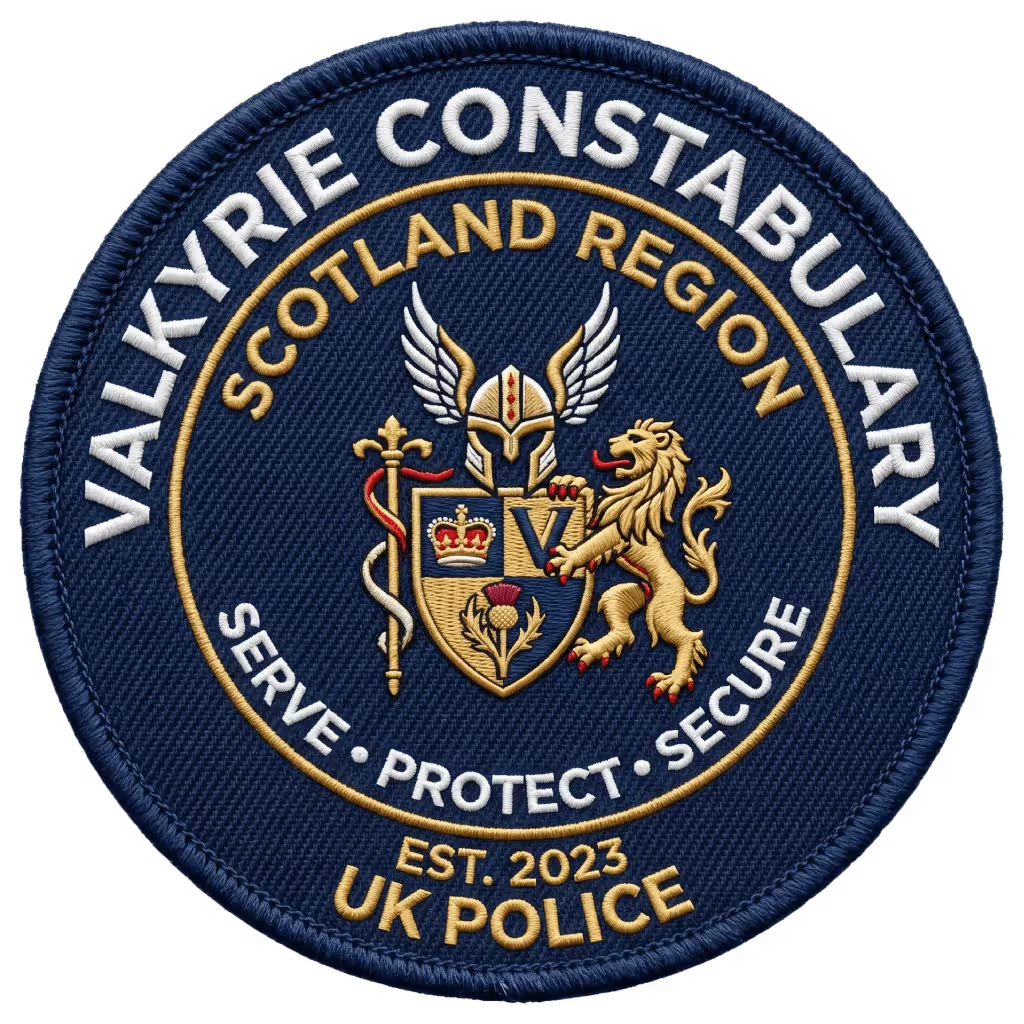
Collar NumbersTactical Gear
What Are Custom Police Patches?
Custom police patches are fabric badges that identify a wearer as part of a police force, special unit, cadet group, or licensed security team. A police patch carries a logo, force crest, rank marker, collar number, or unit name stitched or moulded onto a durable base material. The base fabric is usually twill for embroidered patches and PVC rubber for tactical patches. The patch attaches to a uniform shirt, jacket, plate carrier, or tactical vest through a chosen backing type.
In the UK, police patches serve three core functions: official force identification, structured non-force identification (cadets, specials, training providers), and operational use on plate carriers where Velcro patches need quick swapping. Each function carries its own design, durability, and legal requirements, which this page explains in full.
Types of Custom Police Patches We Produce in the UK
Police patches come in four production styles, and the right choice depends on uniform context, durability needs, and design detail. The table below compares each type at a glance, followed by a deeper breakdown.
| Patch Type | Best For | Durability | Detail Level | Typical Backing |
|---|---|---|---|---|
| Embroidered | Force uniforms, dress wear, cadets | High | Medium–High | Velcro or sew-on |
| PVC / Rubber | Plate carriers, tactical kit, outdoor use | Very High | High (3D moulding) | Velcro |
| Woven | Fine logos, small ID patches, badges | High | Very High | Sew-on or iron-on |
| Reflective | Hi-vis vests, night ops, traffic units | Medium–High | Medium | Sew-on |
Detailed Breakdown of Patch Types
Embroidered Police Patches
Embroidered police patches are stitched with polyester or rayon thread on a twill base and finished with a merrow border for a clean overlocked edge. Thread count for a standard 75 mm force crest sits between 8,000 and 12,000 stitches, which produces dense coverage and sharp text legibility. Embroidered patches suit shoulder titles, force crests on dress uniforms, and cadet badges where a traditional textile finish is preferred. The merrow border resists fraying through repeated laundering, and Pantone colour matching ensures every patch reproduces the exact force colours specified in the design brief.
PVC / Rubber Police Patches
PVC police patches are moulded from soft rubber polymer in a 2D flat or 3D raised relief format and bonded to a Velcro hook backing. PVC resists water, abrasion, and UV damage, which makes it the standard for plate carrier patches, response unit kit, and outdoor tactical use. The 3D moulding process renders fine details (force crests, unit numbers, rank pips) with sharper accuracy than thread embroidery allows. PVC patches also wipe clean of mud, blood, and chemical residue, a property that embroidered patches lack on operational deployments.
Woven Police Patches
Woven police patches use thinner polyester threads woven on a jacquard loom rather than stitched onto a base fabric. The result is a flatter, smoother patch with finer detail resolution, which suits small ID patches, name tapes, and complex force crests under 50 mm. Woven patches lie flush against the uniform and feel less bulky on collar areas or epaulettes. The trade-off is reduced texture: woven patches lack the raised, tactile finish of embroidered work, so they read as more modern and less ceremonial.
Reflective & Hi-Vis Police Patches
Reflective police patches incorporate a retroreflective film or thread that returns light to its source under torchlight or vehicle headlamps. Traffic police, response officers, and night-shift units rely on reflective patches to remain visible at incident scenes and roadside stops. The reflective layer typically sits behind cut-out areas of the design (POLICE wordmark, chevrons) so the patch remains identifiable in daylight and luminous in low-light conditions. Reflective patches usually attach by sew-on backing because heat-press adhesives can compromise the reflective film.
Police Patch Backing Options
Backing type determines how a patch attaches to the uniform, how easily it can be removed, and how long it survives repeated wear. UK police forces, security teams, and cadet groups each have different operational needs, so the correct backing choice depends on use context rather than personal preference.
Hook-and-Loop (Velcro) Backing - Standard for Operational Use
Hook-and-loop backing fastens the patch to a Velcro loop panel sewn onto the uniform, plate carrier, or tactical vest. Velcro is the dominant backing for UK police patches because officers need to swap ID patches, unit identifiers, and morale patches between shifts, training, and deployment without sewing. The backing consists of a stiff hook layer heat-bonded to the rear of the patch, paired with a soft loop panel on the garment. Hook-and-loop attachment holds firm under running, climbing, and physical engagement, yet releases cleanly when the patch needs replacing.
Sew-On Backing - Permanent Attachment for Dress Uniforms
Sew-on backing leaves the rear of the patch as plain twill or fabric, ready to be hand-stitched or machine-stitched directly onto the garment. Sew-on patches stay in place permanently, which suits dress uniforms, ceremonial tunics, and cadet blazers where the patch position never changes. The stitched edge survives industrial laundering at high temperatures, where adhesive backings can fail. Sew-on patches also lie flatter than Velcro-backed patches, giving a smoother, more formal appearance on parade dress.
Iron-On Backing - Convenience for Cadet & Training Use
Iron-on backing applies a heat-activated adhesive layer to the rear of the patch, which bonds to the garment under a domestic iron at 150–180°C for around 30 seconds. Iron-on patches suit cadet groups, training organisations, and short-term event use where speed matters more than long-term durability. The adhesive bond weakens after repeated washing above 40°C and can fail on technical fabrics or waterproof coatings, so iron-on backing is not recommended for operational police uniforms or tactical gear. For permanent results, an iron-on patch can be sewn around the edge after the initial heat-press application.
Common Use Cases in the UK
Custom police patches serve different roles across the UK policing and security landscape, and each user group has distinct design and compliance requirements. The seven use cases below cover almost every legitimate order we receive from UK customers.
Police Force Uniform Patches
Police force uniform patches display the official force crest, divisional name, or rank insignia on Home Office-recognised uniforms. Forces order these patches under purchase order through procurement channels, with artwork supplied directly by the force's uniform department. Production follows the force's approved colourways, sizing, and stitch specifications to maintain visual consistency across thousands of officers. We supply embroidered shoulder titles, force crests, and rank slides to UK constabularies under standard procurement terms.
Special Constabulary & Volunteer Patches
Special constabulary patches identify volunteer officers who hold the same powers as regular officers but serve part-time alongside their main employment. Specials wear the same force insignia as warranted officers, with an additional "Special Constabulary" or "SC" identifier on the shoulder title or epaulette. The design brief comes from the force directly, and patches follow identical embroidery and Pantone specifications to regular force patches.
Police Cadet Patches
Police cadet patches identify members of Volunteer Police Cadets (VPC) units, which are youth schemes run by individual UK forces for 13–18 year olds. Cadet patches carry the force name, the VPC identifier, and often a unit-specific badge for the local cadet group. The design must remain visually distinct from warranted officer insignia to prevent any confusion with operational policing. Iron-on backing works well for cadet polo shirts and softshell jackets, where Velcro attachment is unnecessary.
Plate Carrier & Tactical Vest Patches
Plate carrier patches mount on the front, rear, or side Velcro panels of a tactical vest worn by armed response, firearms, and specialist units. PVC is the dominant material for plate carrier patches because the surface resists mud, water, and friction better than embroidered thread. Standard sizing for a front plate carrier patch is 100 × 50 mm for a POLICE identifier, with larger 220 × 100 mm rear panels for visibility at distance. Hook-and-loop backing is mandatory because officers swap patches between training, deployment, and covert operations. Forces requiring patches for MOD or joint operations may also find our custom military patches relevant for cross-service deployments.
ID Tag & Collar Number Patches
ID tag and name patches display an officer's collar number, name, or rank on a small Velcro-backed strip designed for the ID panel above the warrant card pocket or on the body armour. Standard ID tag dimensions in the UK run 50 × 50 mm, 100 × 35 mm, and 120 × 25 mm, with bolder typefaces for distance legibility. Collar number patches are produced individually for each officer, with the number stitched in white thread on a black or navy twill base. Each patch is digitised separately to ensure the typography and spacing remain consistent across the unit.
Morale Patches for Off-Duty Use
Morale patches are unofficial patches worn on rest-day kit, range bags, or non-uniform tactical gear, often featuring unit humour, mascots, or commemorative designs. Morale patches do not carry official force insignia, so they sit outside the uniform compliance framework and offer more creative freedom on artwork, colour, and shape. PVC is the popular choice for morale patches because the 3D moulding allows sharper logos, bolder text, and unusual outlines. Custom shapes (shields, skulls, regional symbols) are fully supported with laser-cut die lines.
Security & Close Protection Patches (SIA-Licensed Teams)
Security patches identify SIA-licensed door supervisors, close protection officers, event security teams, and corporate security staff. These patches carry the company name, role identifier (SECURITY, CPO, EVENT), and sometimes the SIA licence reference, and they must remain visually distinct from official police insignia. Hook-and-loop backing is standard because security teams rotate kit between assignments and venues. Reflective POLICE-style wordmarks are not permitted on security patches under UK law, security teams use SECURITY, ENFORCEMENT, or DOOR SUPERVISOR wording instead.
Is It Legal to Order Custom Police Patches in the UK?
Yes, ordering custom police patches in the UK is legal when the patches are produced for authorised users (police forces, special constables, cadets, and approved suppliers) or when they are clearly designed as police-style patches for security, training, film, or morale use that cannot be mistaken for genuine force insignia. UK law restricts the unauthorised use of police identifiers, not the production of textile patches in general. We screen every order against this framework before production begins, and the three sections below explain how the rules apply in practice.
How to Design a Custom Police Patch
Designing a custom police patch follows a six-step process that converts a logo or concept into a finished embroidered or PVC badge ready for uniform attachment. If you're ready to begin, our how to order page walks you through the full process from first enquiry to dispatch. Each step builds on the previous one, so accurate input at the artwork stage saves revisions later in production.
Concept and brief
Define the patch purpose (force crest, ID tag, plate carrier, morale), the wearer (officer, cadet, security), and the placement (shoulder, chest, rear panel). Confirm the patch type (embroidered, PVC, woven, reflective) and the backing requirement (Velcro, sew-on, iron-on).
Artwork submission
Send the logo, force crest, or design concept in vector format (.AI, .EPS, .PDF, or .SVG) for the cleanest output. Raster files (.PNG, .JPG) are accepted at 300 dpi minimum, but vector artwork produces sharper digitising and crisper PVC moulds.
Digitising or moulding
Embroidered patches go through embroidery digitising, which converts the artwork into a stitch file (.DST or .EMB) that drives the embroidery machine. PVC patches go through 3D mould creation, where the artwork is sculpted into a metal die for rubber injection.
Digital proof and approval
A digital proof shows the finished patch with exact dimensions, Pantone colour references, stitch direction or PVC layering, and backing type. Customers approve, request revisions, or change specifications before production starts. Free unlimited revisions are included until the proof is signed off.
Production
Approved artwork moves to manufacturing. Embroidered patches are stitched in batches on multi-head embroidery machines, then trimmed, merrow-bordered, and heat-pressed with the chosen backing. PVC patches are injection-moulded, cooled, trimmed, and Velcro-backed.
Quality check and dispatch
Each patch is inspected against the approved proof for colour accuracy, stitch density, border finish, and backing alignment. Patches are packaged and dispatched via Royal Mail Tracked or DPD with a tracking number issued by email.
Artwork Requirements
Vector artwork (.AI, .EPS, .PDF, .SVG) is the gold standard for patch production because vectors scale infinitely without losing detail. Raster artwork (.PNG, .JPG) at 300 dpi minimum is acceptable, but our digitising team may need to redraw small text or fine detail to achieve a clean stitch file. Artwork that arrives as a low-resolution screenshot, a photograph of a printed patch, or a PowerPoint slide will be redrawn from scratch, a service we include free of charge for police, cadet, and SIA-licensed orders. For a full breakdown of accepted formats and file requirements, see our artwork guidelines.
Pantone Colour Matching for Force Colours
Pantone colour matching uses the PMS (Pantone Matching System) reference codes to ensure each thread or PVC pigment matches the exact shade specified by the force or organisation. UK police forces typically supply their official Pantone references on uniform tender documents, and we hold thread libraries that match the most common force colours (force navy, hi-vis yellow, reflective silver, regimental burgundy). Pantone matching is included in every quote at no additional cost.
Sizing for UK Uniform Placements
UK police uniform sizing follows established conventions for each placement on the body. Shoulder titles measure 100 × 25 mm to 120 × 30 mm. Chest crests measure 75 × 75 mm to 100 × 100 mm. Plate carrier front identifiers measure 100 × 50 mm to 150 × 75 mm. Rear plate carrier panels measure 220 × 100 mm to 320 × 100 mm. ID tag patches measure 50 × 50 mm, 100 × 35 mm, or 120 × 25 mm depending on the Velcro panel layout. Custom sizing is available for specialist kit, ceremonial dress, and non-standard equipment.
Pricing & No Minimum Order
Pricing for custom police patches in the UK depends on five production factors: patch size, stitch count or PVC mould complexity, backing type, border finish, and order quantity. The table below shows indicative per-unit pricing for a standard 75 mm embroidered force crest with Velcro backing, ordered in common UK quantities.
There are no setup fees on repeat orders, no charges for Pantone matching, and no separate digitising fees on quantities of 50 patches or more. For a complete price breakdown across all patch types and quantities, visit our full pricing page.
Turnaround & UK Delivery
Standard turnaround for custom police patches is 7–10 working days from artwork approval, and express turnaround is available at 5–7 working days for an additional production fee. Production starts the moment the digital proof is signed off, so delays at the artwork stage push the dispatch date back day-for-day.
Delivery within the UK uses Royal Mail Tracked 24, Royal Mail Tracked 48, or DPD Next Day depending on order weight and customer preference. Tracked delivery is included free on orders over £120. Smaller orders ship from £4.95 with full tracking. Full details on shipping options and timescales are on our delivery information page. We dispatch from a UK production site, which keeps customs, VAT, and import handling out of the equation entirely.
BFPO addresses are accepted for UK forces stationed overseas, including British Armed Forces personnel attached to police liaison roles, with no additional shipping charge. BFPO orders ship via the Royal Mail BFPO route at standard UK postage rates, and tracking is provided to the BFPO entry point.
Why Order Custom Police Patches From Us
Frequently Asked Questions
Order Your Custom Police Patches Today
Bespoke police patches built in the UK give forces, cadets, special constables, and SIA-licensed teams a reliable identifier that holds up across years of operational wear. Our embroidery and PVC production lines deliver Pantone-accurate force crests, durable Velcro-backed plate carrier patches, and individually digitised collar numbers, all dispatched on Royal Mail Tracked from a UK facility. Send your artwork through our quote form, approve the digital proof, and your patches arrive ready for issue inside two weeks. Request your free quote today and see why UK police buyers, cadet units, and security firms return to us — read our customer reviews to find out why.