Custom Military Patches | UK-Made
Custom military patches are bespoke embroidered, PVC, woven or printed badges produced for the British Armed Forces, Cadet Forces, veterans associations and tactical units across the United Kingdom. We design, digitise, stitch and dispatch every patch from our UK workshop, vet regimental orders against MOD authorisation rules, and deliver to civilian, military and BFPO addresses worldwide.
From a single morale patch to a 10,000-unit regimental order, our production team builds patches that survive deployment, parade and plate-carrier wear.
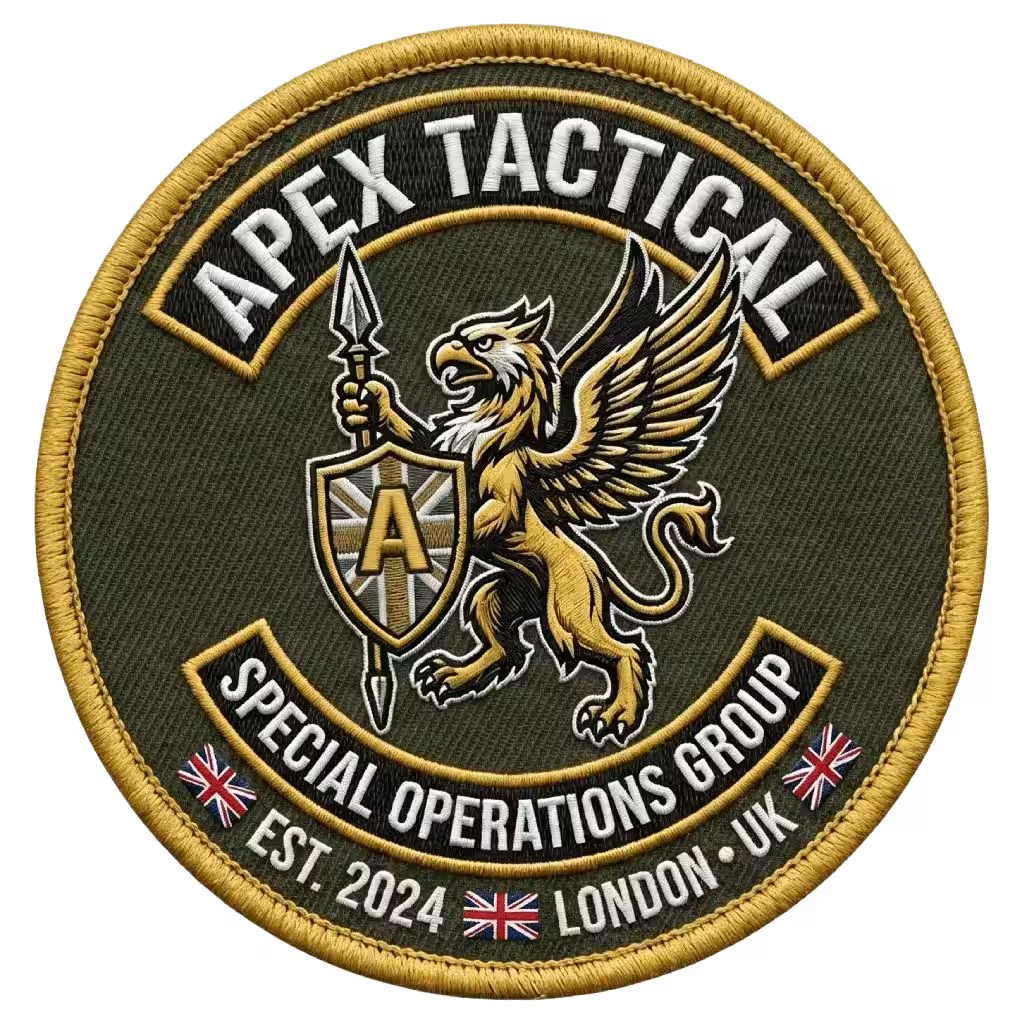
Deploy ReadyUK Workshop
What Are Custom Military Patches?
Custom military patches are personalised cloth, rubber or printed insignia produced to identify a unit, rank, regiment, qualification or role within the armed forces. Each patch carries a specific design, a regimental crest, Tactical Recognition Flash (TRF), formation sign, name tape, or morale graphic, manufactured from supplied artwork or recreated under MOD licensing where authorisation applies.
Every military patch is built from three core layers: a top design layer (embroidery thread, woven fibre, PVC rubber or sublimation print), a structural backing fabric (typically polyester twill), and an attachment method (hook-and-loop Velcro, sew-on edge, or heat-seal iron-on adhesive). The combination of these three layers determines the patch’s durability, fabric compatibility and field performance.
Military patches differ from standard custom patches by their operational role. A streetwear patch decorates a garment. A military patch identifies a soldier, marks a qualification, signals a sub-unit, or carries unit morale during deployment. The patch must hold through field exercises, combat conditions, repeated laundering at military wash temperatures, and abrasion from plate carriers and webbing.
UK military buyers, regimental quartermasters, Cadet Force contingent commanders, veterans associations and airsoft team captains, choose UK production for three reasons. UK-made patches arrive faster, avoid customs delays on regimental orders, and pass through a supplier that understands British military conventions, MTP colour matching, and BFPO logistics.
Types of Military Patches We Produce
Custom military patches are produced in six core types. Each type uses a different surface technique, but all six can be ordered with hook-and-loop, sew-on or iron-on backing. The right type depends on the operational environment, the design complexity, and the uniform the patch will sit on.
Embroidered Military Patches
Embroidered military patches are stitched with polyester thread onto a twill base fabric at 1,500 stitches per square inch. The raised thread surface gives the patch a traditional, premium feel suited to regimental crests, No.2 dress uniform, mess dress and ceremonial wear. Embroidered patches reproduce bold designs with up to 9 thread colours and survive 50+ wash cycles when applied correctly.
PVC Military Patches
Our custom PVC patches are moulded from soft, flexible rubber and bonded to a Velcro or sew-on backing. PVC delivers raised 3D detail, sharp edges, waterproofing, and resistance to mud, oil, sweat and UV exposure. PVC is the dominant patch type for MTP combat uniform, plate carriers, tactical vests and field-deployment wear — see our full range of custom tactical patches for the complete specification.
IR (Infrared) Military Patches
IR military patches contain infrared-reflective fabric that becomes visible under night-vision goggles (NVGs) while remaining low-profile in daylight. IR patches identify friendly forces during night operations and suit Velcro-backed plate carriers. We produce IR Union Jack patches, IR call-sign patches and IR blood-type identifiers.
Woven Military Patches
Woven military patches are produced on a Jacquard loom with fine polyester thread. The weaving process reproduces small text, fine detail and complex sub-unit insignia that embroidery cannot resolve. Woven patches suit TRFs, formation flashes and detailed regimental sub-unit identifiers.
Printed Military Patches
Printed military patches use dye-sublimation to reproduce full-colour photographs, gradients and unlimited colour counts on a polyester base. Printed patches suit deployment commemoration patches, photographic morale designs and exercise patches with complex artwork.
Reflective Military Patches
Reflective military patches use retro-reflective material that lights up under direct light. Reflective patches suit vehicle crews, range safety staff, military police — see also our custom police patches — and high-visibility identification on darkened operating bases.
Military Patch Categories by Function
Military patches divide into eight functional categories. Each category serves a specific identification or morale purpose within UK forces, and each carries different production, authorisation and design conventions.
Backing Options for Military Patches
Military patches use three primary backings. The backing choice is dictated by the uniform, the operational role and the wash regime the patch will face.
When to Choose Hook-and-Loop (Velcro)
Our custom Velcro patches suit MTP combat uniform, plate carriers, tactical vests, helmet covers and any kit where the wearer needs to swap patches between garments. The hook side bonds to the patch; the loop side is sewn to the uniform. UK MTP combat shirts and Osprey plate carriers ship with loop panels pre-fitted, which makes Velcro the default backing for field use. Velcro suits TRFs, name tapes, IR patches, morale patches and rank slides.
When to Choose Sew-On
Sew-on backing suits No.2 dress uniform, mess dress, ceremonial wear, blazers and any garment that must hold the patch permanently. Sewn thread bonds the patch mechanically to the fabric, which survives commercial laundry temperatures and prevents the patch from lifting under hot wash. Sew-on is the standard backing for regimental association blazers, veterans’ beret badges and parade dress.
When to Choose Iron-On
Iron-on backing suits unit merchandise, veterans’ civilian wear, regimental association T-shirts and personal kit applied at home. The heat-seal adhesive bonds the patch in 30 seconds with a household iron. Iron-on suits cotton, polyester, denim and canvas, but does not bond to nylon, leather, Gore-Tex or any waterproof technical fabric used in combat clothing.
We produce all three backings in-house. Our team recommends the correct backing once you confirm the uniform fabric, the operational use and the wash regime.
UK Military Patch Compliance & MOD Regulations
Custom military patches in the UK sit under a layered legal framework. The framework covers Crown copyright, regimental trade marks, the Army Act 1955, the Uniforms Act 1894, and MOD intellectual property licensing through Defence Intellectual Property Rights (DIPR). Any UK manufacturer producing military patches must understand which designs are reproducible on open order, which require authorisation, and which are restricted entirely.
Crown Copyright & MOD Trade Marks
Crown copyright protects designs created by Crown servants in the course of their duties. Regimental cap badges, formation signs, RAF squadron crests and Royal Navy ship’s badges are Crown-protected works. Reproduction for commercial sale requires a licence from DIPR or the regimental headquarters that holds the design rights. Veterans’ associations, regimental museums and unit welfare funds typically hold standing licences for their own insignia.
Section 197 of the Army Act 1955
Section 197 of the Army Act 1955 makes it an offence for any person not serving in HM Forces to wear the uniform of the Armed Forces in a manner calculated to bring contempt upon the uniform, or to impersonate a serving member. The Act does not prohibit ownership of military patches or replicas; it prohibits their use to misrepresent military status. We supply patches; the wearer carries the legal responsibility for context of wear.
Trade Marks Act 1994, Cap Badges & Regimental Symbols
The Trade Marks Act 1994 registers regimental cap badges, RAF roundels, the Royal Navy ensign, the Combined Services badge and other military marks as protected trade marks. Reproduction for sale to the general public without authorisation infringes the registered mark. Reproduction for authorised members of the regiment, cadet contingent or veterans’ association sits inside the licensed use.
Authorised vs Unauthorised Insignia
Serving units, Cadet Force contingents, regimental associations, official welfare funds and MOD-contracted suppliers are authorised to order their own insignia. Members of the public, film productions, re-enactors and airsoft teams sit outside the standard licence and require either a separate licence, a clearly fictional design variant, or restriction to morale-only patches that do not reproduce regimental marks.
Our Position on Military Patch Orders
We verify regimental and cadet orders against contingent registration, regimental association membership, or MOD supplier credentials before production. Morale patches, airsoft team patches, fictional unit patches and clearly non-regimental designs proceed on standard production. Unauthorised reproduction of Crown-protected designs is declined.
Industries & Units We Serve
We produce custom military patches for every category of UK Armed Forces, Cadet Forces, reservist units, veterans’ organisations and tactical civilian groups. Each category orders patches in different volumes, with different backing preferences, and against different authorisation routes.
British Army Regiments & Corps
British Army regiments order TRFs, regimental flashes, formation patches, qualification badges and tour patches for their serving soldiers. Orders typically pass through the regimental quartermaster or PRI (President of the Regimental Institute). Standard order volumes range from 200 patches for a sub-unit to 5,000 for a full battalion roll-out.
Royal Navy & Royal Marines
The Royal Navy and Royal Marines order ship’s badges, commando flashes, branch insignia and morale patches. Royal Marines Commando units use PVC patches extensively for plate carriers and combat equipment. Ship’s badges follow a strict College of Arms format and require authorisation from the ship’s commanding officer.
Royal Air Force (RAF) Squadrons
RAF squadrons order squadron crests, flying badges, mission patches and detachment patches. Squadron crests reproduce Latin mottos, heraldic devices and unit symbols approved by the Inspector of RAF Badges. Detachment patches commemorate overseas deployments and exercises.
Combined Cadet Force (CCF) & Schools
School-based CCF contingents order contingent patches, section flashes, qualification badges and house patches. Orders pass through the contingent commander or school’s CCF office. Cadet patches typically use embroidered or woven construction with sew-on backing for No.2 dress.
Army Cadet Force (ACF), Sea Cadets & Air Cadets
Independent cadet units order detachment patches, county badges, qualification flashes and shooting badges. Air Cadet squadrons follow RAF squadron crest conventions. Sea Cadet units follow Royal Navy ship’s badge conventions.
Military Reserves & Reservist Units
Army Reserve, Royal Naval Reserve, RAF Reserves and Royal Marines Reserve units order the same patch range as their regular counterparts. Reservist orders frequently include unit-specific morale patches reflecting the part-time service identity.
Veterans Associations & Regimental Associations
Regimental associations order blazer badges, beret patches, commemorative patches and reunion patches for ex-serving members. Embroidered patches with merrow borders dominate this category, as veteran wear is dress-uniform-focused rather than tactical.
Airsoft Teams & MilSim Groups
UK airsoft teams and MilSim groups order team patches, call-sign patches, fictional unit patches and morale patches. Airsoft patches use the same construction as authorised military patches but carry fictional unit designs.
Defence Contractors & Private Military Companies (PMCs)
UK defence contractors, security firms and private military companies order company patches, contract patches and identification patches for personnel deployed on government contracts.
The Design & Production Process
Custom military patches move through a six-stage production process from brief to dispatch. The process applies to every patch type and every backing option, with authorisation checks inserted at stage three for regimental orders.
Brief & artwork submission
Send your design as JPG, PNG, PDF, AI, EPS or SVG — see our artwork guidelines for full file specifications. Hand-drawn sketches and written briefs are also accepted; our design team converts them into production-ready artwork at no extra cost.
Free design proof & digitising
Our in-house team digitises the artwork into machine-ready stitch files (for embroidery and weaving) or 3D moulds (for PVC). The first proof is delivered within 24 hours.
MOD / regimental authorisation check
For regimental, cap badge and Crown-protected designs, we verify the order against contingent registration, regimental association membership, or MOD supplier credentials.
Sample approval
A physical sample is produced and dispatched for approval on bulk orders above 200 units. Digital proofs are sufficient for smaller orders.
Production
Embroidered patches stitch at 1,500 stitches per square inch. PVC patches mould in heat-pressed silicone tools. Woven patches run on Jacquard looms.
Quality control & dispatch
Every patch passes a visual QC check before packing — backed by our quality guarantee. Orders dispatch via Royal Mail Tracked, DPD or BFPO depending on the destination — full details on our delivery page.
Pricing & No Minimum Order
Custom military patch pricing depends on the patch type, the size, the colour count, the backing and the order volume — visit our full pricing page for a detailed breakdown. Larger orders unlock volume pricing; smaller orders carry a higher per-unit cost.
| Patch Type | MOQ | Lead Time | Best For |
|---|---|---|---|
| Embroidered | No minimum | 7-14 working days | Regimental crests, blazer badges |
| Woven | No minimum | 7-14 working days | TRFs, fine-detail unit flashes |
| PVC | No minimum | 10-15 working days | MTP uniform, plate carriers |
| IR (Infrared) | No minimum | 10-15 working days | Night operations, NVG identification |
| Printed | No minimum | 7-10 working days | Photographic deployment patches |
| Reflective | No minimum | 10-15 working days | Vehicle crew, range safety |
Single-patch sample orders are available on request for design verification before bulk production. Express production reduces lead times by 3-5 working days for an additional fee. Bulk orders above 1,000 units unlock tiered pricing, contact our team for a regimental quote.
Durability, Care & Tactical Performance
Custom military patches last for years of operational use when produced to the correct specification and maintained against the right wash and care regime. Patch durability depends on three factors: the construction quality, the backing strength, and the laundering conditions the uniform passes through. Field use, plate-carrier friction and military wash temperatures all shorten patch lifespan when ignored.
Washing & Care for Military Patches
Embroidered, woven and PVC patches survive standard military wash regimes at 40°C on a cotton cycle. MTP combat uniform is typically laundered at 60°C, which sits at the upper safe limit for hook-and-loop backing. Wash garments inside out, avoid bleach, and air-dry where possible. Tumble-drying degrades the Velcro hook side and weakens iron-on adhesive.
IR Patch Maintenance
IR (infrared) patches require specific care to preserve their infrared signature. Do not iron the patch directly, do not bleach, and do not soak in fabric softener. Fabric softener coats the infrared-reflective surface and degrades NVG visibility over time. Hand-wash IR patches separately or remove them from the Velcro panel before laundering the uniform.
Plate Carrier Friction & Velcro Lifespan
Plate carriers and tactical vests exert constant friction on patch edges through movement, kneeling and prone positions. Hook-and-loop backing survives 200+ attachment cycles under standard use. Patches mounted in high-friction zones (chest, shoulders) wear faster than patches in low-friction zones (back panel, helmet cover).
Reinforcement Stitching for Combat Use
For permanent military patch installation on combat uniform, reinforcement stitching extends the patch lifespan to match the life of the garment. A single line of polyester thread around the patch perimeter, applied by sewing machine or by hand, prevents edge lifting under prolonged field use. Reinforcement stitching takes five minutes per patch and applies to every patch type we produce.
Why Choose Us for UK Military Patches
We are a UK-based custom patch manufacturer producing military patches for the British Armed Forces, Cadet Forces, veterans associations and tactical units across England, Scotland, Wales and Northern Ireland. Every patch is designed, digitised, stitched and dispatched from our UK workshop, which keeps lead times short, quality control direct, and the supply chain transparent.
Our Customers Reviews
Frequently Asked Questions
Order Your Custom Military Patches Today
Send your brief, your artwork, or your regimental authorisation details to our UK production team. We respond within four working hours, deliver a free digital proof within 24 hours, and dispatch your patches via Royal Mail, DPD or BFPO worldwide. From a 10-patch cadet detachment order to a 10,000-unit regimental roll-out, every patch is made in the UK to military-grade specification.